The Sylva Herald Columns
Some of you complained about not being able to access the columns in The Sylva Herald, and since I’m probably finished with that effort now, I’m posting the final, edited versions (minus Quintin’s titles) below. Most of them are reduced versions of blog entries already posted, except the last one and one other one. Thanks again to Quintin for suggesting it and editing it.
I wanted to add that in addition to the many kind people who donated generously to my cause, many of you have recently volunteered to drive me back and forth to radiation in Asheville. For that, and for all the other kindnesses I’ve received–sometimes from total strangers–I thank you from the bottom of my heart.
______________
1.
This spring I began a kind of journey. We all know someone who made it. My need to make sense of it resulted in a blog, and I was asked to tell parts of that story here. It’s a story without an ending, and it’s not for everyone. But it takes place here, my chosen home of more than 20 years, so here seemed a good place to tell it.
Late last year, several people I love “got” cancer. That was hard. My mother entered a graduated-care facility. We began selling the house I thought of as home. I felt I’d lost my main support system all at once, and I spent a week watching old movies like “The Sound of Music” (my ultimate story of family and acceptance) and eating fried things. But I still thought these things only happened to others.
On March 18, however, I was diagnosed with breast cancer, which in the screenplay of my life felt like some hack writer just gave up, recycling the same plot over and over again.
On Monday, March 14, I had a routine mammogram – a friend’s cancer made me think of it. The tech saw the mass immediately and was able to flag the film and get it to a doctor. By 2 p.m., I received a call from a lovely person whose actual title is Breast Navigator. It makes the breast sound like terrain so horrid that heroes must subdue the monsters in it.
By Wednesday, an ultrasound revealed “spiculated edges,” which aren’t the good kind of edges. By Thursday, I had a biopsy surrounded by a posse of dear friends who entertained the waiting room arguing about which Golden Girls they were.
By Friday, I had a diagnosis, with just the basics – 2.5 centimeter invasive ductile carcinoma (that’s the most common kind of breast cancer); 2.5 cm means stage two.
I started the process of telling my family, and spent the weekend watching reruns and huddling with my dogs with a weird unreal scream in my head.
What anyone knows who has lived through something like this is the paradox of not wanting to be alone and not being able to stand talking, especially because of the litany of things I didn’t know.
I knew it was going to be really, really expensive. But I hadn’t spoken to a single doctor, just the awesome breast navigator who is apparently paid so that doctors can shrug and look at each other funny and then hand you her card. I was so grateful for the love behind the questions, but every question made me tired. I kept remembering part of an Auden poem:
“Time can say nothing but I told you so,
Time only knows the price we have to pay;
If I could tell you, I would let you know.”
By March 21, I learned about cancer grade, calculated by the number of tubule cells in the mass (many is good) and rate of mitosis (slow is good). I had a grade two cancer at two o’clock on the posterior wall of my left breast.
I’d learn that my cancer was receptive to estrogen, which makes it the most treatable kind. And I’d learn what no doctor ever told me: Breast cancer has risk factors, some due to estrogen collecting in your body (weight gain, inactivity, eating soy, using the pill), some developmental (early puberty, not having children or breast feeding) and some – drinking and smoking – that echo like an “I told you so” from your seventh-grade health teacher. You win again, evil Miss Schraeder!
Luckily, my tumor floated somewhere not attached to anything I really needed, like the chest wall. I met with a local surgeon and asked for a mastectomy.
But in the next two weeks – cancer’s a course you take quickly – I would learn a lot about mastectomies, lumpectomies and cosmetic surgery. It turns out that if you’re overweight like me, mastectomies could leave big ridges of fat and make your chest look like a half-melted marshmallow.
From a weekend spent poring over support blogs and journals, I learned what I only distantly understood before: once it’s part of your life, it knows the way to your house, like a creepy colleague, and could pop back up when you think it’s gone, like one of those awful songs in your head – I’m talking about you, Muskrat Suzie!
So welcome, cancer, to the rest of my life. And to those of you who live with it, I’m sorry I just didn’t get that before. Empathy takes forever to keep learning.
2.
This installment of my cancer journey talks about my trip to the surgeons. It will contain some breast-related graphic detail.
Following my March 18 diagnoses, I plunged into the vortex of research, factoids and innuendo. Since 20 to 30 percent of women will get a recurrence after treatment, I wanted the “right” surgery, and I had little time to decide. Treatment for breast cancer usually starts with the surgery, though it’s sometimes preceded by chemotherapy. Afterwards, you can have some combination of chemo, radiation and hormone suppressing therapy if you have the right kind of cancer (I do) for five to 10 years.
I stopped by the hospital to get my films, so I saw the offending monster for the first time. If you have a mass in your breast (246,660 women and 2,600 men will get breast cancer in 2016), you want it to be smooth, like a jellybean with hard edges. You do not want it to look like mine – something out of “The Andromeda Strain.”
Local docs referred me to Asheville surgeons, but my excellent friend Clare had recently done good research on Atlanta surgeons, so I was able to just show up at their offices. And by just show up, I mean that I brought friend Kaleb along not only for emotional support and note taking but in one case to be exhibit A, and that I drafted friend Ken to drive us in case my brain shut down, and that we all left at zero-dark thirty in the pouring rain, and that I dragged Clare out of her house to help me think of questions. I brought along the slides, and pathology reports and a big-pink leaflet-choked breast binder, and 4,000 pages of forms, and my insurance information and my Star Trek checkbook.
Though I’d planned on mastectomy, I learned if you keep even part of your original breast, you have a slightly greater chance of cancer recurrence but no worse life expectancy (from now on these girls would get a lot of scrutiny. They would not make a move without a note from the doctor). And in most cases, breast cancer recurs not in the breast but somewhere else where you are not looking.
Mastectomy would improve my odds of escaping chemo and radiation – if they didn’t find cancer in nearby lymph nodes. The plastic surgeon in the gorgeous Buckhead office gave me three reconstruction options besides implants (of course, you can opt to “go flat,” which has its advantages, including cool tattoos and snap-on breasts). One was mastectomy plus Goldilocks, where they reconstruct a small breast-mound out of tissue left over from the breast right after mastectomy—all while you sleep! It’s less elaborate than option two – a Diep Flap, which involves liposuctioning fat from the belly for a larger breast. I will spare you even more details than I already just gave you against your will.
The main advantage with a mastectomy plus Goldilocks: I probably wouldn’t need radiation. But mastectomy takes the muscle that keeps breasts at attention, so to speak, and a Goldilocks doesn’t add that back. That’s why implants are popular. Kaleb was playing with some samples marked “not for resale” on them while we waited for the doctor. Implants are spongy and symmetrical; they’d make great stress relievers (one had a substance called “Memory Gel”).
My friends who have implants look great. However, the ever-swelling binder had a 16-page set of “pros” and “cons” about implants. Most list “cons” – and those are pages written by the implant companies! They are filled with paragraphs a little like this: “As of today, no long-term studies have conclusively linked implants to autoimmune disorders, hair loss, nose loss, insanity, two-headedness, exploding navel syndrome, spontaneous skin sloughing, or carnivorous succubus-hatching. However, studies are ongoing.”
The third option was “Oncoplastic Reduction,” where you remove the lump and then reduce the other breast to match. You have just one less extensive surgery, and you get smaller, more life-like breasts. But with any lumpectomy you need radiation.
Between doctor visits, and aided by the Google maps lady who lives in my phone, I got us horribly lost. We also stopped to see (former Commissioner) Veronica Nicholas in rehab from her much more intensive glioblastoma treatment (it would be a heart-breaking year of cancer for many women I knew). She looked amazing, thin, and as always joyous and generous, even in the midst of chaos. And Kaleb took a selfie with a Bernie Sanders look-alike in the background.
The next stop was a cancer surgeon (if you’re going to get simultaneous mass removal/ mastectomy and reconstructive surgery, you need two surgeons at once). She reassured me that my lymph nodes felt OK, but she stressed they never really know what they’ll find until they operate; in my case, I’m thinking a bunch of those wind-up monkeys with tambourines.
3.
After a long weekend of thinking about how to deal with cancer, I decided on the Oncoblastic reduction and prostrated myself before the insurance Gods.
“Get it out” had become my new mental mantra. Every headache, gas pain or tingle convinced me that Parnell, as I liked to call my tumor, had metastasized, and of course I didn’t know whether it had or hadn’t. Like my friend Laura, I assume all disaster is due to me not anticipating it hard enough or long enough. Therapists have explained that this is superstitious thinking, but they just haven’t seen a direct correlation between their unpreparedness and doom from above. It’s a burden.
So to keep myself busy, I went for genetic counseling and testing. If you have a family history of breast cancer – I do not – they like to see if you carry a gene that predisposes you to cancer. You have probably heard of the best known susceptibility, which is related to the BRCA genes. The BRCA gene test is a blood test that uses DNA analysis to identify harmful changes (mutations) in either one of the two breast cancer susceptibility genes – BRCA1 and BRCA2. But only about five to 10 percent of cancer is inherited. They also like to test you if you got cancer before you were 50 (no), or if someone in your family got it under 50 (no) or if you had triple negative cancer before age 60 (no-triple negative means, among other things, that your cancer doesn’t respond to hormones), or have male breast cancer (no) or a history with ovarian cancer (not that I know of).
The chances of my having inherited the BRCA gene mutation were pretty low. But there are other, familial kinds (30 percent of breast cancers are “familial,” so if your family has certain kinds of cancers that are genetically related, your chance of getting those cancers goes up). The doctors tested me because my family had an odd “cluster” of different cancers. The problem with testing, of course, is that you could find out about a predisposition you could do nothing about (for example, taking out your stomach or pancreas in anticipation of cancer doesn’t seem to be an option.)
Though my results took some time, my cancer – like most cancers – turned out to be “sporadic,” which means it responds to environment or lifestyle. I asked my genetic counselor what I could do to keep my genes from mutating in this obnoxious way. It was too late to do most of them, like start puberty later and have a child earlier. The pill, hormone therapy, weight gain, smoking and, of course, drinking could contribute.
I asked three different doctors about drinking. One said drinking modestly increased your chance of breast cancer, but the risk was outweighed by the benefits to your heart. I liked this doctor best! Another said drinking more than two drinks per week (and by drink, they don’t mean one of the gallon goblets) doubles your chance of recurrence. A third told me to become a vegan. But none could say whether changing any of those things about yourself, once you already have cancer, would help in the slightest.
Meanwhile, just about everyone I see seemed to have heard about my breast cancer. I honestly didn’t know how to feel about that. One of my favorite poems by W.H. Auden talks about the way Dutch masters painted the dark times of our lives: Never in the absolute center of the canvas, but over to the side or falling off the edge, because they knew that people do not stop living their lives just because something happens to you. I can relate to this, because while part of me wants to live life normally, another part wants the entire internet to stop what it is doing and take notice. I can’t explain it, but there it is.
I went to get pre-qualified for surgery by my primary care doctor, which went well (despite the Goldfish crackers, both my weight and my sugar are down since early March). The funniest part was that the doctor’s office had recently revised their EKG-giving policies and so sent me up and down to various offices at least four times until I stopped moving and promised to stand in the lobby singing Gilbert and Sullivan songs until the staff reached a consensus.
After lying splayed forlornly on a table, I got my EKG but had no idea what it said; I hoped it wasn’t a secret coded message to chop off my head when I presented it to the surgeon. It was actually labeled “Mary Adamds.” I hoped that didn’t cause me to get no surgery while someone named Mary Adamds got carved up despite her unheeded screams.
4.
For this edition, here’s Part One of Things I’ve Learned That You Should know. These insights might not be as useful to you if you don’t live in a place like Sylva, but I will strive to extend the life lessons to the . . . three of you, or whoever is still reading.
Get mammograms, even if you aren’t at risk for cancer, especially after 40. (If you didn’t have children before age 30, some insurers consider you “high risk,” so you can get a yearly mammogram paid for). One in five women will get breast cancer, most without any genetic predisposition. You may have to ask to be referred. When you get the referral, a radiology receptionist may tell you they don’t take appointments in person, so you should call from your cell phone while they are still shoving you out the door. Such a conversation resulted in my losing my form and waiting an extra six months to find out I had cancer.
In Sylva, your first resource is the breast navigator employed by Harris Regional Hospital. Keep her number. She’s kind, she’s direct, she will tell you the truth, and she can get you access to other doctors, films, pathology reports and lab tests.
The breast navigator will make you an appointment with a local surgeon. Don’t go in demanding a mastectomy, as I did; make the doctor tell you all surgical possibilities. You are entitled by law to breast reconstruction, but not all procedures work for everyone; for example, if your tumor is right under the nipple, it’s much harder to do a lumpectomy.
But if the surgeon only tells you about a procedure that will take multiple hospitalizations months apart, exposing you to the risk of clots and superbugs, and give you implants (which usually result in more surgeries), you aren’t getting all the alternatives, and you should see another surgeon in a city like Atlanta (which has great options besides big research hospitals). Do this right away.
Ask for all the tests you can get, and ask for copies of all those tests. More information is good, but sometimes our corporate overlords at the insurance company don’t want to pay for it. Worry about that later. In general, worry about money later (See installment two of Things I’ve Learned, which hasn’t been written yet). Genetic tests are good, because if you find out your family has a bad cancer, your daughters and sisters can get discount testing too. Genomic tests give you good information about the kind of cancer you have (not all cancers respond to chemotherapy) – and sometimes they find errors in your first pathology report. And (p.s.) if you have a high risk of estrogen-related cancer (family history, early menses, no pregnancies or breast-feeding before age 30, overweight, a drinker, a smoker, or a user of the pill or hormone-replacement therapy), the affordable care act says you might be able to get preventive hormone-suppressing therapy paid for.
Get second opinions, and again, don’t be afraid to go out of town. Sylva doctors cover lots of territory, traveling all over the region. They are eminently qualified. But I’ve learned about “no” practices and “yes” practices. For example, my breast surgeon and plastic surgeon gave me their email addresses and actually responded to my emails. At the “no” practice, the receptionist tries to get you to go away. In the “yes” practice, it’s someone’s job to get you an answer within a stated time. “No” practices get extra training in doubletalk. I’ve met some great people – doctors, nurses, receptionists, techs – and I’ve received great care.
But wherever you go, if you get treated like a 4-year-old, or if you leave a note for your doctor and it is still sitting in her inbox three weeks later, or if you get forwarded to the “bad cop” who tells you she’ll decide whether your message is worth passing on, or if you wait three hours for an appointment, or the office staff send your test results to the wrong patient and laugh about it, or if the billing department doesn’t say you overpaid because “you didn’t ask,” then you can do better. Cancer is not just care; it’s big business. So make the practice work for you.
Get good insurance, because mortality is coming, shedding like it rolled in some icky tinsel. We need universal health insurance or else universal “not” insurance – that is, we go back to the days when we can barter a goat for a new breast. What’s scary about aging is the way the gods start to pick off the people you love without warning.
This year took a huge toll on my friends, my soul and my wallet – and my friends’ wallets and souls. To age, you need insurance. Anyone who wants to doom you to eternal poverty and fear because you have a pre-existing condition or because you work three jobs that don’t pay the bills or your spouse took off with your life savings – well, that’s just greed. Love one another, says the book – or at least don’t begrudge a good 80/20 plan.
5.
I had tests: bloodwork and a “dual-energy X-ray absorptiometry (DXA) scan” or “bone densitometry,” which is a scan to figure out how much bone loss I had, as a baseline for when I began taking bone-killing hormone-suppressing therapy – which would be after the radiation therapy – which would be after chemo, if I needed it. My left knee looked bad. I also learned I didn’t have genetically inherited cancer, so I was back to “sporadic,” which means the cancer was caused by some other mysterious factor: food, environment, stress, Law and Order re-runs, not having a baby, red licorice, Star Trek re-runs, pallor, poetry, polyester, voting for Hillary, and/or religion. And wine.
They want you to cut out most vitamins and supplements somewhere between two months and two days before surgery. No one said when. So I turned aside once again to the Valley of the Shadow of the Internet for advice, which is ubiquitous and, as you might expect, contradictory. You should have Vitamin C and zinc before surgery – or maybe not. You definitely shouldn’t have fish oil before surgery, but you should start it up right after surgery. Or two weeks later. The other things you definitely shouldn’t have: Vitamin E, Ginko Biloba, Ephedra, Ginseng, Ginger, St. John’s Wart, any pain relievers, garlic – and, of course, wine.
Wine. First, it was good for heart disease. Then it was bad, but just for women. Avoid it till menopause, lest you injure your unborn child. Or just don’t drink until everything falls off or gets unrecognizably wrinkly.
Without wine, I had no distractions – the television signal at my house having been shaded out by fate, and Cannabis being illegal, and cheese being fattening. These were gratifying weeks in terms of people reaching out, but they were also some of the loneliest weeks of my life. Many people were unsure what to say, and my ambivalence about talking didn’t help them.
In this way, I suppose, life with cancer wasn’t that different from life before cancer, except for that scream keening softly in my head. Cancer was dull, too, yet all I ever talked about. Getting to the point where you could talk about something else seemed impossibly remote. They should have a dark-pink ribbon for that, resembling your tonsils, or maybe a chip like you get in 12-step programs.
The day of my surgery, three of my sisters flew down. The day began when we wandered into the wrong admitting office with a newly hired employee who tried to help me fill out papers. Like me, she had trouble reading the health insurance documents, quoting me a price somewhere between $2,500 and $90,000 (I’d given up trying to decipher anything from my health plan, which seemed to involve computing the value of pi in many directions). Then she asked for my living will – just in case of coma or death, she added cheerfully.
She escorted us to a tasteful waiting room that had overstuffed chairs and screens you could use to check the stage of surgery of your loved one, if you knew the secret code. After I got hooked up to an IV and was draped in awkward surgical garb, my sisters came in to wait, and we entertained the entire staff for a couple more hours until surgery.
I remember nothing until I awoke in recovery with some kind of medieval corset, a strange black box wired to my left bosom with saran-wrap and purple sandpaper that occasionally emitted sounds. The Black Box of Flatulence had a large drain tube I had to trip over for a week. For the first time in decades, I could see past my breasts to my feet.
My hair had been arranged in a bizarre top-pointing ponytail like something out of Dr. Seuss. (One wonders how doctors resist the temptation – if they do – to dress their anesthetized patients in Yoda costumes or pose them with life-size models of celebrities.) I’d love to describe how much radioactive green dye came out of me when my purgative powers were eventually restored – but I won’t, since this is a family friendly paper.
6.
The results of my pathology, which came in several days after surgery, were mixed. When you get a lumpectomy, they remove only your sentinel (nearest) nodes and send them off to a lab (a mastectomy takes longer, so they’re usually able to test nodes and, if they see cancer, to remove the secondary or axillary nodes while you’re still sleeping). The surgeon got good margins around my tumor, which had grown to about 2.8 cm. I had two sentinel lymph nodes, one of which was clear, while the other had a 9mm mass in it, with part of that mass having moved beyond the node into the lymph channel, where it can spread elsewhere. This is a complication called extracapillary extension (ECE) that meant my surgeon, a careful and somewhat taciturn sort, wanted to check with the tumor board.
I spent the first weekend in utter despair because I googled ECE (when you do, you come up with studies mostly written in a strange mathematical shorthand littered with phrases like “recurrence” and “poor prognosis.”) I gathered that it probably meant more involved axillary nodes, chemotherapy, definitely radiation, and possibly another surgery, but my emails to my surgeon produced only cryptic one-line responses like “yes” and “maybe” and “that’s not a very good study.” So I waited. And I advise you, if you yourself decide to get cancer, to not only find good surgeons, as I have, but to also make sure they are not too stingy with explanations and the occasional encouraging platitude.
While the prospect of chemo was daunting, the reconstruction was fascinating. I weighed about six pounds less post-surgery, which if you think about it is like unloading most of a gallon-container of milk.
My breasts were also lifted (they cut a large key-hole shape, remove breast tissue from the middle and bottom parts of the hole, and then move the nipple to the top of the keyhole.) The skin was stretchy, but not quite enough, because when they tried to sew the two parts under the keyhole together, one large hole remained that would teach me a great deal about wound care.
Meanwhile, as data came in, I gained an education into current breast-cancer thinking, which it turns out is a grey area of studies, philosophies, competing predictor models, metaphysics, luck, gut instinct, and other stuff. I say grey, because the science surrounding my kind of cancer straddles the historical divide between the recent past, when they threw chemo at everything, and the near future, when they will tailor the treatment to the tumor’s genome.
For example, the question of a second surgery. Since surgeons didn’t initially remove my additional nodes, to go back in and remove them later, and then irradiate them, would have upped my chances of lymphedema to more than 50 percent (lymphedema happens when your lymph fluids can’t drain properly). So many doctors argued first among themselves, and then with me, about whether to do a second surgery. What was the likelihood that cancer had spread to the other nodes?
Luckily, the nation’s two leading cancer centers have online “nomograms” to help you guess. Sloan Kettering said I had a 12-percent chance of additional node involvement. MD Anderson said my chances were 67 percent. Predictably, the “tumor board” in Atlanta that debated my treatment went many rounds on this question of cutting out the nodes or not. One shining young radiation oncologist and breast enthusiast (he recognized the skilled hand of my plastic surgeon at once) spent an hour first telling me to have surgery and then telling me not to have it. The final decision was that, since I was likely to have chemo anyway, we would skip the second surgery and let chemo and radiation chase down the putative stray cells as they cascaded headlong through my hapless blood stream.
But then came the debate about chemo—one that is still ongoing. Online predictors suggest that the benefit of chemo for someone like me is small but substantive, adding two percentage points to my five-year survival chances. But the Predict Tool (imagine pink letters and a breast-cancer ribbon in place of the “i”) isn’t tailored to the particular biology of one’s particular tumor. For this, you need to go to one of many obscenely expensive services that give you a genomic profile of your cancer. The best-researched of these is called the Oncotype DX.
My next installment, which I have not written yet, will explain why this score threw all my experts into a frenzied debate, and how I decided what to do next.
7.
When last we met, I was explaining why I couldn’t decide whether to have chemo.
The new standard for determining chemo-readiness for breast cancer patients is the Oncotype DX, a $4,000 test that your insurance won’t cover unless your lymph nodes are clear of cancer – mine weren’t.
My surgeon ordered the test anyway, because it does predict chemo effectiveness (and survival rates) for people with lymph involvement.
The Oncotype test looks at 21 genomic thingies to predict how receptive your cancer is to estrogen, progesterone and such.
It gives you a score (and a graph) between one and 100, and if your score is low (one to 18), the thinking is that chemotherapy definitely will do more harm than good, and you have a low chance of your cancer returning. If your score is high (31 and above), then chemotherapy is definitely for you, because without it your cancer has a higher chance of recurring. If your score is intermediate, they have just thrown up their hands.
To add to the confusion, the test’s “validators” broke down the scores differently, and they haven’t yet validated the intermediate scores.
My score was 19, which is either the lowest possible intermediate score, or right smack in the middle of intermediate, depending on whom you ask. If you look at the graph, 19 is right at the point where the line that says, “chemo won’t help you a bit” crosses the line that says “chemo will be your savior.”
The company says that with my lymph-node involvement, my cancer had a 12-percent chance of recurring in the next five years, with chemo or without chemo.
First of all, that’s a pretty good score, so I don’t want to sound ungrateful. But it only confused me more. For academics and “true believers” like the second oncologist I saw in Atlanta, you must love the Oncotype DX with all your soul and with all your might.
“If you do chemo, it will be an emotional decision, not a rational one,” he said loftily.
For my local oncologist, and other doctors I asked, relying on the Oncotype DX alone and not choosing chemo is just too risky. Maybe because they’re uncertain about the data, or maybe because not recommending chemo hangs them out to dry if someone gets a recurrence and says, “If only I’d had chemo!” After all, if you never know why cancer recurs, you will always think the one thing you didn’t do was the deciding thing.
“It’s different out here in the real world. Chemo is still the standard of care,” one doctor said.
For insurers, an “extended” node always means chemo. But the true believers say radiation will take care of the lymph node.
“Are they sure?” asks another doctor. “What if a tiny cancer cell has traveled somewhere else and is waiting to hatch?”
They point to the fact that the new chemotherapy drugs may work better (the Oncotype test predicts your odds using the old chemotherapy drugs).
“The truth is, we never know,” admitted my oncologist, about three weeks after I’d given in and started chemo (yes, I decided to do it. I needed to try everything).
In other words, in 10 more years, everyone is going to know a whole lot more, but my cancer was happening now. And even though time feels circular and arbitrary, it is still linear where it hurts.
The choice is complicated, because the new chemo drugs have large odds (about 15 percent) of causing long-term-to-permanent loss of brain function, weight gain, hair loss, neuropathy and maybe leukemia. Of all these, I loved my brain. Was it so important that death would be preferable to losing it? I did not know. It was such a classically literary dilemma that it required epiphany. I needed to speak to the writer.
Meanwhile, I was healing, but there was still a one-centimeter hole in one breast. To prevent “tunneling,” I packed them twice a day with various stuff, including some odd little strips called “lodoform packing strips” that looked like confetti; so far, all were gross and yet inadequate. I was learning about the kindness of strangers. Good people gave me free haircuts in preparation for chemo and free hats for my pitiful bald head. One day, my tire exploded, and two people stopped to help me. One even hugged me. People will tell you I’m not a hugger, but I’ve become humbled by the willingness of strangers to hug me anyway. Maybe they sense how scared I am.
Weirdly, it helps. Or maybe it’s gratitude that helps, if you’re willing to make a habit of it. I’m not good at it, but I’m learning.
8.
Finally, my course of treatment was determined: I would have 12 weeks of chemotherapy (four rounds intravenously every three weeks), then six weeks of radiation, and finally 10 years of hormone suppressing therapy (pills). And lots more tests.
Meanwhile, my oncologist ordered body scans just in case the cancer had spread already. Besides a baseline mammogram, which would make sure no visible cancer had recurred in the new breasts, I had a bone density scan (I have osteopenia, and I’m actually getting shorter!) and a bone scan (the disk I obtained through the tender mercies of the navigator had a picture of a Halloween skeleton with my name on it, from several angles).
Also, I needed a CT scan of my guts. I admire radiologists who read these things; I have no idea what each organ is. The photos show only large, undifferentiated constellations of chaos in which some of my Facebook friends think they see a dead squirrel, the hand of a vestigial twin, or the burgeoning fetus of Golem.
Even the radiologist must finally have thrown up her hands and concluded formally that “additional floating things” had been detected and required further investigation. In other words, they could be masses, or blood vessels, or fatty intrusions, or hemangiomas, or spare change. The main concern was a four centimeter mass in my uterus and an unidentified flying object in my liver.
First of all, if people look at your insides, they are going to find things, most of which will turn out to be nothing. But at least 15 percent of breast cancer patients will get a recurrence, and recurrences aren’t good news. Moreover, some first-time breast masses have already metastasized, and sometimes the mass itself is a metastasis of another cancer that’s hiding out somewhere. (Uterine and ovarian masses, for example, are hard to detect without an ultrasound; the stirrup exam you get from your gynecologist really only screens for cervical cancer.)
In seconds, my oncologist was on the phone, ordering an MRI of my liver and a Transvaginal Ultrasound. She called to spring the news before I had even made it to my car. You may choose to be impressed at her speed; I decided to go home and panic until my MRI appointment.
On Facebook, I posted a photo that accurately shows what it took to get me in that MRI machine; picture a therapist, a bouncer, a cattle prod, and a slumber mask with a large bottle of Ativan right beside it.
I suspect market research has proven that women’s voices are more soothing, because the voices of machines in all of my doctors’ offices are female. “Going up,” says the elevator warmly. “Please pay $10 now,” trills the Parking Validation machine. But for some reason, the inventors of the MRI machine in Sylva added none of the frills (films of butterflies, soothing elevator music or Cappuccino maker) to their Bagel of Doom.
So it shouldn’t have surprised me that the Harris MRI voice is an angry, masculine cross between an obscene phone caller and a mansplaining garbage disposal. “Breath in!” it grates, then “Hooooold your breath!” followed by a series of long guttural beeps.
The MRI had been ordered to get a better look at a mass in my liver, which turned out to be “probably nothing.” However, the Transvaginal Ultrasound, which sounds like either a Seismic Phenomenon or a really scary ride at Dollywood, was called in to examine a four-centimeter mass in Ladytown, as a friend calls it. It had to be done in a different office, because it needed a surgeon who specialized in gynecological cancers.
Sitting with your feet in stirrups as someone waves a wand, gray blobs undulating about the screen, while a doctor, two technicians, and a nurse try to figure out which if any of those blobs are your ovaries — let’s just say it undermines your faith that medicine is a science. Apparently, Ladytown had well and truly closed up shop, so these new tests were no more conclusive than the others.
Therefore, we decided on a hysterectomy. The mass needed to be identified, and Ladytown itself is like a vengeful, estrogen-secreting mystery planet from Star Trek, waiting to attack. The plan was to do it before chemo, but getting back in touch with the doctor (or the nurse or the scheduler or the scheduler’s assistant) to expedite that appointment proved difficult. I threatened to stand in the waiting room singing Ave Maria (singing gets results in doctors’ offices, but only if it’s extremely loud).
I still have no appointment. Maybe December. While the doctor’s rummaging around in there, I hope she’ll take out any other parts I don’t need.
9.
Chemotherapy starts with chemo class, which is where a nurse practitioner sits down and opens a giant binder between you. The giant binder is about possible side effects of chemo, possible interactions with other drugs, possible organs that might or might not explode and teeth that will possibly fall out, and possible fatal diseases that could happen down the road because of chemotherapy.
She lists all the things you won’t want to eat, and suggests solutions for the discomfort that will inevitably ensue: “Take your temperature.” “Buy mouthwash.” “Exercise.” “Do not go outside in the sun.” “Do not drink.” “Watch out for mouth sores.”
My sister-in-law Peggy, a funny, nurturing person, tried hard to lighten the mood, but binder discussions are always serious. Binder discussions, of course, are preferred for any aspect of cancer: “You have a 2.8 cm mass.” (Turn laminated page.) I have accrued at least seven binders.
The chemo room has rows of long, vinyl, reclining chairs that look just like the ones at old-timey hairdressers, only instead of hair dryers there are IV stands. A television hangs from the ceiling playing Andy Griffith episodes too softly to help those who haven’t already memorized them.
Most of the denizens of the chemo room are women, but there’s little gossiping or female bonding like in “Steel Magnolias.” Fortunately, a friend came to keep me company and lighten the mood. She’d just had knee surgery, so she did PT exercises to pass the time, hopping up and down on her chair until most people were laughing except one alarmed lady, who kept exclaiming, “Are you OK, honey?” and “Bless your heart!”
Each visit, you get a full blood panel, then an IV drip of steroids. They put two infusions into you. It takes about four hours. Some people get a port inserted surgically, but inevitably it gets clogged or stops working.
My first week of it was less awful and yet more icky than I anticipated. I saw the world through a lens of ground glass and antifreeze. Everything seemed brighter and harsher and, somehow, louder. Everything smelled like plastic.
I also got terrible headaches, the kind at your temples when your brain is trying to escape with a small hammer, and by the end of the week I had several visual migraines, which made it feel like the ground glass was dancing around me.
The other major side effect was due to the white-cell booster called Neulasta; its white paper says, “This medicine is used to stimulate the growth of ‘healthy’ white blood cells in the bone marrow.“ The quotes suggest the white blood cells are only pretending to be healthy. Common side effects make the chemo sound like an aspirin – exploding spleen, pain in your “upper left stomach,” and bone pain.
The awful pain in my lower back four days later induced me to call the help line.
“It’s really bad,” I said, panting.
“It’s a little late to have these symptoms,” the doctor replied skeptically.
“Ow,” I replied.
“Take three ibuprofen then, or go to the ER.”
“I thought I wasn’t allowed to have ibuprofen,” I gasped, on my knees (my supper companions were inside watching through a big storefront window, so I imagine I looked like a dying character in a Chaplin movie).
The doctor laughed. “Oh, that’s just something we like to tell people.”
My cocktail was Taxotere and Cytoxan, which I once used to treat my dog’s cancer (it did not work). If you Google Taxotere, the first thing you will see are ads for lawyers to help you sue the manufacturers of Taxotere. That’s because a certain percentage of people never really get their hair back after treatment. But I’m rooting for mine. Heh! See what I did there? Rooting?
And speaking of rooting, I visited a wig shop called Secrets of a Duchess, which sounds like a romance novel. The store’s proprietors are a Chihuahua and a wigged British ex-patriot who gives you pretzels.
Doctors cannot write you a prescription for a wig, but they can write one for a “cranial prosthesis.” So don’t go asking for a wig – you will simply reveal your ignorance.
I hadn’t realized how many women suffer from various kinds of alopecia (baldness). One younger woman, in the midst of chemo, was sobbing because she didn’t think her husband would love her without her hair. Other more seasoned veterans dashed into the store, wigs in hand, demanding a styling.
It made me wonder about the women I see every day, covering some perceived imperfection with dignity and some sort of “prosthesis”—stick-on boobs, implants, wigs, spanx and girdles, makeup, gel eyebrows, push-up bras, compression bras, contact lenses, even deodorant for all the private places.
Every woman is haunted from infancy lest her secret ugliness be discovered, that thing that keeps her from ideal beauty like a missing password to the human-race party. A good wig store – even one with coffee and pretzels – isn’t your ticket out of the freak show; it’s just a rare look into the faces living gracefully with what you’re hiding with all your heart. “Guts,” as my friend Maida used to say. “That’s what it takes to be a pumpkin.”
10.
This last installment brings us up to the present. I hated my 12 weeks of chemotherapy, but they were far less awful than most other people’s. Besides losing my hair and some symptoms of nausea, neuropathy and fatigue, I faired pretty well. The hair usually comes back thinner and changed in color and/or texture, so I am reasonably prepared. In many ways, cancer changes things forever.
Estrogen cancers, for example, mean estrogen blockers that induce menopause (if it hasn’t already started) and/or a hysterectomy, along with bone loss and hot flashes. So cancer closes a door suddenly on “the hour of splendor in the grass” (I’m quoting Wordsworth, who was nostalgic for his youth before it ever ended).

I am going to Asheville for my six weeks of daily radiation treatments (these are standard for anyone who gets a lumpectomy, but more important for me because my cancer had moved into the tissue around my lymph nodes). Lots of nice people stepped forward to help drive me, which was an amazing gift.
My treatments happen as I lie supine under a twinkling photograph from the Hubble telescope. They began with a CT Scan, tattoos and a simulation. Because my tumor was close to my heart, I hold my breath during each treatment. I use a plastic beaker with an elephant’s trunk to practice inhaling till a small rattling plastic dot is suspended within a smiley face, then try to hold my breath for about a minute. Many get a bad sunburn, so doctors recommend aloe or moisturizers.
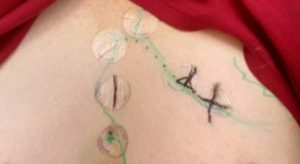
The technicians drew on me with green and black markers. The slope of my reconstructed breast is steep, so the designs consist of shapes, squiggles and dots reminiscent of a Paul Klee painting.
If you get cancer, people will send you dozens – maybe hundreds – of cancer stories. They are all different but alike. You’ll get sick of them. Here’s what helped me: Doing research, asking for help, and learning to take it. Here’s what didn’t help: People who think they can tell you how to handle it or why you got it or whether you deserved it.
Yes, smoking is bad. Yes, watch your diet. Yes, get health insurance, so you get regular testing. But why some get cancer and others don’t is a big fat mystery.
My advice: Ask more of doctors than they’re likely to offer. Demand ultrasounds of your lady parts, for example, even if you have to figure out which symptoms to fake to get them.
Also, spend the money to take care of yourself. If you don’t have health insurance, the prices are different, and most doctors will accept small, regular payments until the end of time. If your insurance is bad, or if you have huge out-of-pocket expenses (and they keep getting higher), don’t worry about it now. Just spend it.
The giant book about cancer, “The Emperor of All Maladies,” says radiation as a cancer treatment was first discovered in the 19th century, thousands of years after Egyptian surgeons first unsuccessfully operated on it. Hippocrates named it after crabs (“canker”) or crayfish (“carcinos”) because it seemed to have many legs, but in Shakespeare’s time surgeons took Hippocrates literally and assumed it was a worm that thrived on excess melancholy.
The first chemotherapy was derived from mustard gas. By the 1950s, doctors realized cancers behaved differently and had to be treated differently, and by the 1960s, they began to experiment with combining multiple treatments. Until then, cancer was always a bottomless sea of sadness for both patients and doctors, and of course for many it still is.
My odds are good, even if breast cancer travels mysteriously. While I’ve had to think about my own mortality, I’ve moved through the process while people I love have been diagnosed with it and died of it. Some live with the fear of it returning every day.
And I’ve heard stories about survivor guilt. The question of who gets cancer and who survives it seems random. It makes unlikely fellow travelers cling to each other like tired swimmers who don’t know when the next wave will hit – and who will be “immensely drowned” (Richard Wilbur). The forks and breaks in our timeline are written cryptically into our bodies – the very bodies that mold us into ourselves.
To those who’ve shared their stories with me, thank you for helping when I was alone. To those whom I’m losing or have lost – George, Randy, Betsy, Paul, Karen, Veronica, and so many others – I will miss you forever. To those who have loved them, I hope my stories have not made light of theirs. And for those who, like me, are still paddling along – well, here is a hand for you, if you need it, and thanks for yours.
4 thoughts on “The Sylva Herald Columns”
Thanks for posting these here, Mar. You are a beautiful writer, and a beautiful human. I”m proud to be related to you. xoxoxo love, Anne
Thank you for letting us into your mind, heart and body so we can learn more about being human.
Thanks for your continued updates. I so admire your positive attitude and your sense of humor during this ordeal. Best wishes.
Mary, your journal has of lately become my Virgil, but read in embarrassment and shame. Last night I dreamt, that I was lost in a vast empty parking lot, perfectly and evenly painted spaces shown bright under dim, flickering amber lights, and a few paces away, a darkened lump lying in the lane rose up like a mountain in an endless desert. I slowly approached and immediately recognized myself, seeing through the naked body, x-ray vision, moving past my skin, my flesh, blood and bones, with fixed stare. I could see inside my throat my cancer had come back, pulsating with outreached sinuous tentacles creeping up and down my veins and arteries, intertwined like a wild rose wrapping itself around my backbone. It had gotten a complete hold of me from the inside, unseen to the rest of the world. This cancer pulsated in the colors of a negative imaged rainbow, colorless, but beautiful, and all the while sucking hungrily at my throat. I awoke coughing, startled and convinced, it was back. Last night was the second night after my surgery to have cancer removed from my vocal chord.
I say I read in embarrassment and shame, because what I am facing, what I am going through seems so insignificant compared to the millions of children and adults who are faced with forms so horrendous that I cannot even imagine what they must go through. And it makes me confused, that I should be spared the pain and anguish of a more serious nature, and yet, I privately, ashamedly, am grateful that I am not. You write of survivor’s guilt, “And I’ve heard stories about survivor guilt. The question of who gets cancer and who survives it seems random. ” Maybe that’s what it I feel, a mixture of relief, but an incomplete understanding of its randomness, of its sinister plotting to attack. I felt so violated thinking about the way this thing was growing and feeding inside me all this time, quietly, but annoyingly, letting me know in its own way it was there even when I didn’t know it or feel it.
It’s not a club membership any of us joins willingly and the application process and dues seems to vary from initiate to initiate, but I have come to realise that membership has one important perk that no other association could ever offer, and that is the strength, love, and understanding that those before us, those with us, and those that are to come, have for one another. And for that I am extremely grateful. -murat
Comments are closed.